What is Permissioned Asset Standard?
On Sui, any object with the store ability can be freely transferred by its owner. Balance and Coin both have store, meaning if you hold them, you can send them anywhere on the network with no restrictions.
This works well for general-purpose assets, but creates a problem for regulated assets that need transfer controls, compliance checks, or issuer oversight.
The Permissioned Asset Standard (PAS) solves this by proxying asset ownership through Accounts: objects that hold assets and enforce a closed-loop system where every movement is gated by programmable approval logic.
You can use PAS through the TypeScript package or learn more in the GitHub repo.
How it works
For each wallet address (or object ID), PAS creates a one-to-one derived Account. An Account is a shared object that holds assets on behalf of that address. The owner can prove ownership through an Auth proof, but cannot freely transfer the assets. This creates a proxy of ownership where the assets follow the constraints of PAS modules, and sequentially, the rules that an issuer defines across one or more packages through approval witnesses.
Every time funds move, they go through hot potato requests that must collect a predefined set of approval stamps (witness structs) before they can resolve within the transaction. Hot potato requests have no drop or store ability, so the transaction aborts if the request is not resolved.
The following diagrams compare asset ownership with and without PAS:
Without PAS

With PAS
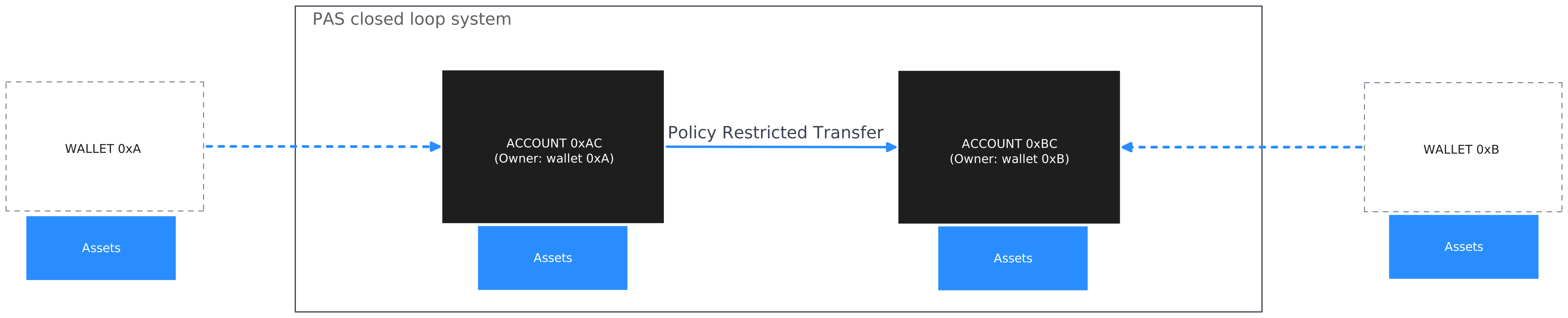
Each asset type can have its own policy that defines which witnesses are required to approve each action. This means different assets can adhere to completely different rules. One asset might require a single compliance stamp, while another might need approvals from multiple independent contracts.
The result is that assets are held in a closed system where every movement is gated by programmable, composable approval logic that the issuer defines at the policy level.
There is no way to transfer a managed Balance<C> out of the system without going through a request that collects the required approvals.
For currencies, this is enforced at the Move type level:
-
Balance<C>is stored inside Accounts usingbalance::send_fundsandbalance::redeem_funds(derived object storage). -
The only way to move funds is through request hot potatoes that must be resolved in the same transaction.
-
Resolution requires matching the approval set defined in the
Policy<Balance<C>>.
Object model
The following diagram shows the PAS object hierarchy:
Namespace (shared, singleton)
├── Account (@0xAlice)      ← derived from (namespace_id, AccountKey(alice_addr))
├── Account (@0xBob)        ← derived from (namespace_id, AccountKey(bob_addr))
├── Policy<Balance<C>>    ← derived from (namespace_id, PolicyKey<Balance<C>>)
│   └── PolicyCap<Balance<C>>  ← derived from (policy_id, PolicyCapKey)
└── Templates             ← derived from (namespace_id, TemplateKey)
All objects use derived addresses (sui::derived_object), making them deterministic and queryable without onchain lookups.
Namespace
The Namespace is the root of the system. Its responsibilities include:
-
Deriving addresses for Accounts, policies, and templates
-
Holding the
Versioningstate for emergency version blocking -
Keeping the
UpgradeCapUID to gate admin operations (version blocking, setup)
Account
Accounts are shared objects derived from the Namespace UID and the owner address.
| Property | Detail |
|---|---|
| Creation | Permissionless. Anyone can create an Account for any address. |
| Ownership | Wallet address (ctx.sender()) or object (UID). |
| Storage | Holds Balance<C> as object balance, or T directly as objects on the Account UID. |
| Derivation | derived_object::claim(namespace_uid, AccountKey(owner)). |
Policy
A Policy<T> defines resolvable actions for a managed asset type T:
-
Required approvals: Per action type (
send_funds,unlock_funds,clawback_funds). -
Clawback flag: Whether issuer clawback is allowed.
-
Versioning: Synced from Namespace. Can block package versions.
For currencies, you create a Policy<Balance<C>> through policy::new_for_currency(&mut namespace, &mut treasury_cap, clawback_allowed). This requires TreasuryCap<C> as proof of currency ownership.
PolicyCap
The capability to manage a policy. Derived one-to-one from the policy UID and PolicyCapKey. You use it to:
-
Set or update required approvals per action
-
Remove action approvals (makes requests for that action unresolvable)
The request pattern
Every state-changing operation in PAS follows the request hot potato pattern:
-
Create: An Account method wraps data
Tinto aRequest<Action<T>>. The request starts with an empty approval set. -
Approve: Your package calls
request.approve(MyWitness())to stamp the request with a type-level proof. You can collect multiple approvals from different packages. -
Resolve: A resolution function verifies that the collected approvals exactly match the required approvals in the policy, destroys the request object, and either executes an action or unwraps data.
Request types
The following are the available request types:
-
Request<SendFunds<T>>: Transfer between accounts -
Request<ClawbackFunds<T>>: Issuer funds withdrawal -
Request<UnlockFunds<T>>: Withdraw from system as the owner of funds
Approval matching
Approvals are matched by type identity using TypeName. The approval set must be exactly equal (same types, same count, same order through VecSet insertion) to the policy required approvals.
In the current version, each action supports only a single approval witness. Multi-approval support (requiring stamps from multiple independent contracts) is planned for a future release.
For example, a TransferApproval witness struct defined in your contracts:
// Policy requires: { TransferApproval }
// Request has:     { TransferApproval }  ← resolves
// Request has:     { TransferApproval, ExtraApproval }  ← aborts (count mismatch)
// Request has:     { WrongApproval }  ← aborts (type mismatch)
Balance tracking
PAS uses Sui Address Balances:
How balances are stored
The following diagram shows how balances attach to an Account:
Account (shared object)
  └── UID
       └── Balance<MY_COIN> stored via balance::send_funds(balance, account_object_address)
Balances are not stored as fields on the Account struct. They are stored as object balance on the Account UID, using balance::send_funds to send funds to the Account object address and balance::withdraw_funds_from_object (through UID.withdraw_funds_from_object) to pull them out.
Balance flow
The following diagram shows deposit and withdrawal paths:
Deposits are permissionless (anyone can deposit into any Account). Withdrawals are internal (public(package)). Only PAS modules can withdraw, and only through requests.
Wallet ownership compared to object ownership
Accounts can be owned by wallet addresses or objects.
The following example shows both authentication methods:
// Wallet-owned: proves ownership via transaction sender
let auth = account::new_auth(ctx);

// Object-owned: proves ownership via UID reference
let auth = account::new_auth_as_object(&mut my_object_uid);
Derived object addresses
All PAS objects (Accounts, policies) use deterministic derived addresses. You can compute them offchain:
// Get the account address for an owner
let account_addr: address = namespace.account_address(@0xAlice);

// Get the policy address for a type
let policy_addr: address = namespace.policy_address<Balance<MY_COIN>>();
Security model
PAS provides the enforcement primitives (closed loop, type-safe approvals, atomic resolution), but it does not enforce your business or compliance policy. Deciding who can transfer and under what conditions is your responsibility, implemented in your approval witnesses before calling request.approve(). Because the approval witnesses are the only gate on asset movement, audit them carefully: a flawed or overly permissive witness undermines the entire closed loop. See access control.
PAS guarantees the following:
-
Closed loop: Managed assets cannot leave the system without going through a request with matching approvals.
-
Type-safe approvals: Approval witnesses are checked by
TypeName. You cannot forge an approval from a different package. -
Atomic resolution: Requests are hot potatoes. They must be resolved in the same transaction or the transaction aborts.
-
Deterministic addressing: All objects use derived addresses. There is no hidden state and no non-deterministic object creation.
PAS does not support or guarantee the following:
-
Access control: PAS does not decide who can transfer. That is your contract's job through approval witnesses.
-
Compliance rules: PAS does not enforce rules. Your contract implements those before calling
request.approve().
Trust boundaries
| Component | Trust level |
|---|---|
PolicyCap<T> holder | Can change approval requirements for T. |
TreasuryCap<C> holder | Can create a policy (one-time) for Balance<C>. |
Account owner (Auth) | Can initiate send or unlock from their Account. |
| Anyone | Can create Accounts, deposit, sync versioning. |
| Approval witness package | Controls who can approve requests. |